Facts About Xunantunich That Will Surprise You
Short answer. The frieze you photograph is a replica. The name is nineteenth-century and comes from a ghost story. Two carved panels in the royal tomb were quarried from another city's staircase. And the first archaeologist to dig here took the glyphs away.
Xunantunich is not the biggest Maya site in Belize and it is not the most famous. What it has is an unusually good set of specific stories, and most of them contradict what you will arrive expecting. Here are the ones worth knowing before you climb, and None come with a guide who can point you at each of them.
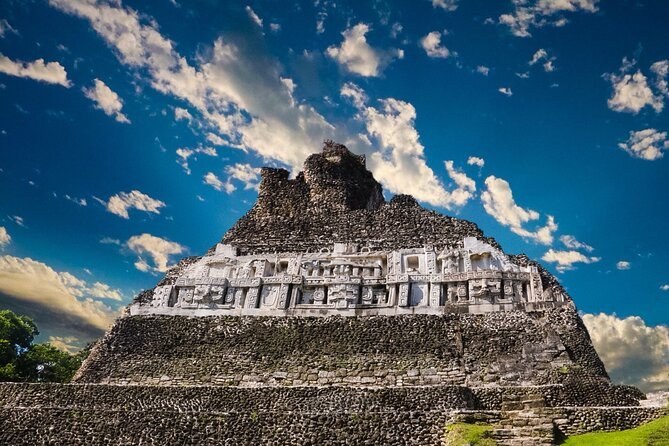
The frieze on El Castillo is a copy
The band of modelled stucco you will photograph is a replica. The originals are preserved underneath, sealed for their own protection, and the Getty Conservation Institute carried out the work between 1992 and 1996. It is a conservation decision rather than a reconstruction: what you are looking at is a faithful cast laid over the real thing, and you would need permission and a trowel to see beneath it.
The frieze once wrapped all four sides of the upper temple's roof panel; fragments survive on the east and the west. The structures page sets out what each surviving section depicts.
The name is modern, and it is a ghost story
Xunantunich means Stone Woman, or Maiden of the Rock, in Yucatec and Mopan Maya. It is pronounced shoo-nan-too-nich. What almost nobody realises is that the name is only about a century and a half old and it is not the city's own.
It comes from a story told locally in the nineteenth century about a woman in white who appeared at the foot of the pyramid and vanished into the stone. The ancient name of the city is not known, so the thing you are climbing is named after somebody's ghost.
Two panels in the royal tomb came from another city
When Jaime Awe's team opened the burial chamber in Structure A-9 in 2016, they found two carved panels that had not been made here. Panels 3 and 4 were cut from a ceremonial staircase commissioned at Caracol in 642 CE, and Christophe Helmke deciphered them.
They record the Snake-head dynasty's move from Dzibanche to Calakmul, and Panel 3 carries a death statement for Lady Batz' Ek, who died in 638 CE. Somebody transported a rival city's political monument here and reused it in a tomb, which is the sort of thing you only find out by asking.
🏛 Did You Know? The A-9 chamber is the largest Maya burial found in Belize in a century of excavation. The history page puts it in the sequence of digs from Thomas Gann in 1894 to BVAR today.
The first archaeologist took the glyphs away
Thomas Gann dug here in 1894 and 1895 and returned in 1924. On that second visit he removed burial goods and the glyphs from Altar 1, and where they ended up is not known. Early archaeology in the region was frequently indistinguishable from collecting, and this site carries the loss.
It was the first Maya site in Belize to open to the public
In 1954. Before that, visiting a Maya city in what was then British Honduras meant an expedition rather than an afternoon. Xunantunich has therefore been receiving visitors for longer than any other site in the country.
The ruling family walled themselves in as the city fell
Structure A-1 was raised, with A-13, only in the ninth century, and it divides Plaza A-I from Plaza A-II. The reading archaeologists give it is uncomfortable and specific: as the Classic political order across the lowlands came apart, the people at the top of this city built a wall between themselves and everyone else.
The admission price nearly tripled and the internet has not caught up
Entry rose from US$5 to BZ$25, about US$12.50 in 2025, and photo ID became a requirement at the same time. A great deal of published advice still quotes the old figure. The facts page keeps the current numbers.
There is probably no ball court
Several tour descriptions mention one. The reserve's own plan board, posted at the entrance, marks the plazas, the aguada and Groups B to D — and no ball court among them. It is a good example of a claim that spreads between listings without ever being checked against the site itself.
It is second-tallest, not tallest
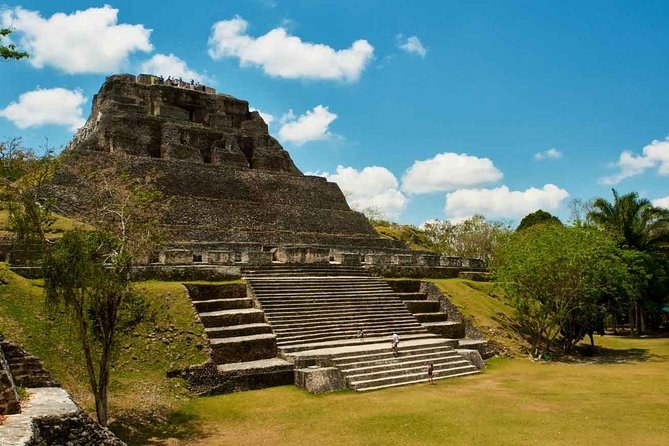
El Castillo stands 130 feet above the plaza floor, which makes it the second-tallest structure in Belize. Caana at Caracol, deep in the Chiquibul, is taller. What you get here instead is accessibility: fifteen minutes from a town, against three hours of forest road to reach the taller one.
A doctor, a photographer and a ceramicist built the record
The people who worked out what Xunantunich is were not, for the most part, professional excavators. Thomas Gann was a medical officer. Teobert Maler was a photographer who produced the first plan of El Castillo for the Peabody Museum in 1904. J. Eric S. Thompson built the first ceramic chronology for the region in 1938 — and it is that unglamorous piece of pottery-sorting that made every later date at the site possible.
Modern work is continuous rather than episodic: the Xunantunich Archaeological Project ran from 1991 to 1997 and remapped the central precinct, and Jaime Awe has been digging on and off since 2000.
The city may have ended suddenly, or slowly, and the argument is still live
Euan MacKie's Cambridge expedition of 1959 and 1960 excavated the upper building of Structure A-11 and proposed that a sudden disaster — possibly an earthquake — ended Classic occupation here. It is a striking hypothesis and it is still quoted in guide patter today.
Later work has largely favoured the slower regional collapse that took the whole lowland Maya system with it. Both readings survive in the literature, and standing in front of Structure A-1 — the ninth-century wall — you can see why a gradual unravelling fits the architecture better than a single bad afternoon.
The facts at a glance
| Fact | The detail |
|---|---|
| The frieze | Replica; originals sealed beneath, conserved 1992–96 |
| The name | Stone Woman; nineteenth century; not the ancient name |
| Panels 3 and 4 | Cut from a Caracol staircase commissioned 642 CE |
| The A-9 tomb | Found 2016; largest in Belize in a century |
| Opened to visitors | 1954, the first in Belize |
| Height | 130 feet; second-tallest in Belize |
| Admission | BZ$25, about US$12.50, up from US$5 in 2025 |
The site opened to visitors before it was understood
Xunantunich has been receiving the public since 1954, which is decades before most of what is now known about it was established. Thompson's ceramic chronology was only fifteen years old; the frieze conservation was forty years away; the A-9 tomb was sixty. Visitors have been climbing this pyramid for longer than archaeologists have been able to tell them what happened on it.
What a guide adds to all this
Not one of the stories above is signposted at the site. The structures carry almost no interpretation, so if you walk it alone you will have a pleasant hour and learn very little. You can hire a guide at the crossing for about US$30 for two people, or book a departure that includes one and have your transport, your admission and your guide handled together.
Every one of these comes out of the excavation record, and a licensed guide on the ridge will show you where each of them happened — which stone Gann took the glyphs from, where the A-9 chamber sat. Xunantunich Tours compares the departures that include one.
Tours with a guide who knows the excavation record
Private Xunantunich Mayan Ruin with local Lunch from Belize City
PrivateLunchFees included
From $200 per person